| [1] |
刘旭光. 论“美感”:历史演绎与构成分析[J]. 求是学刊, 2021(4):127-137.
|
| [2] |
Diaz A. Embracing Leadership in Mental Health Settings: An Employee Assistance Program for Occupational Therapists Facing Burnout and Compassion Fatigue[C]. In: Proceedings of the 2011 AOTA Annual Conference; 2011: 45-50.
|
| [3] |
Lutz J, Herwig U, Opialla S, et al. Mindfulness and Emotion Regulation—An fMRI Study[J]. Social cognitive and affective neuroscience, 2014, 9(6): 776-785.
|
| [4] |
Rodríguez-Carvajal R, Lecuona O. Mindfulness and Music: A Promising Subject of An Unmapped Field[J]. International Journal of Behavioral Research and Psychology, 2014, 2(301): 1-9.
|
| [5] |
刘潇林. 正念冥想影响音乐审美情绪加工的作用机制[D]. 西南大学博士论文, 2021.
|
| [6] |
Lei L I U, Hong-Fang Y U, Zhao-Yang C. The Influence of Mindfulness Training Level on Emotional Processing[J]. Journal of Psychological Science, 2016, 39(6): 1519.
|
| [7] |
Jon Kabat-Zinn, University of Massachusetts Medical Center/Worcester. Stress Reduction Clinic. Full Catastrophe Living: Using the Wisdom of Your Body and Mind to Face Stress, Pain, and Illness[M]. Delta, 1990.
|
| [8] |
刘旭光. 作为共通感的美感——审美之中的共通感问题研究[J]. 文艺理论研究, 2018(3):6-16.
|
| [9] |
Leder H, Belke B, Oeberst A, et al. A model of Aesthetic Appreciation and Aesthetic Judgments[J]. British journal of psychology, 2004, 95(4): 489-508.
|
| [10] |
Sayers W M, Creswell J D, Taren A. The Emerging Neurobiology of Mindfulness and Emotion Processing[J]. Handbook of mindfulness and self-regulation, 2015: 9-22.
|
| [11] |
何沛然. 基于符号学理论的竹山剪纸文创产品设计研究[M]. 景德镇陶瓷大学硕士论文, 2021.
|
| [12] |
Lei L I U, Hong-Fang Y U, Zhao-Yang C. The Influence of Mindfulness Training Level on Emotional Processing[J]. Journal of Psychological Science, 2016, 39(6): 1519.
|
| [13] |
Liu S, Tong J, Meng J, et al. Study on An Effective Cross-stimulus Emotion Recognition Model using EEGs Based on Feature Selection and Support Vector Machine[J]. International Journal of Machine Learning and Cybernetics, 2018, 9: 721-726.
|
| [14] |
[英]阿兰˙德波顿, [澳]约翰˙阿姆斯特朗著, 陈信宏译. 艺术的慰藉[M]. 武汉: 华中科技大学出版社, 2019.
|
| [15] |
Shapiro S L, Carlson L E. The Art and Science of Mindfulness: Integrating Mindfulness Into Psychology and The HelpingProfessions[M]. American Psychological Association, 2009.
|
| [16] |
Goldie P. The Mess Inside: Narrative, Emotion, and The Mind[M]. Oxford University Press, 2012.
|
| [17] |
Allen R. The Effects of Mindfulness-based Art Therapy on Stress and Cortisol Levels In Graduate and Professional-level Students[D]. The Florida State University, 2017.
|
| [18] |
Zeki S. Statement on Neuroesthetics[J]. Institute of Neuroesthetics, 2009.
|
| [19] |
Solso R L. The Cognitive Neuroscience of Art: A Preliminary fMRI Observation[J]. Journal of Consciousness Studies, 2000, 7(8-9): 75-86.
|
| [20] |
Kawabata H, Zeki S. Neural Correlates of Beauty[J]. Journal of neurophysiology, 2004, 91(4): 1699-1705.
pmid: 15010496
|
| [21] |
Edelman G M. Bright Air, BrilliantFire[M]. New York, NY, USA: BasicBooks, 1992.
|
| [22] |
Cela-Conde C J, Marty G, Maestú F, et al. Activation of The Prefrontal Cortex in The Human Visual Aesthetic Perception[J]. Proceedings of the National Academy of Sciences, 2004, 101(16): 6321-6325.
|
| [23] |
King N. Mindfulness-based Art Therapy: A Review of The Evidence Base[J]. Art & Therapy, 2013. 30(1), 4-13.
|
| [24] |
Kramer R. S. Mindfulness in The Arts:Theory, Research, and Applications[M]. New York: Springer, 2014.
|
| [25] |
[宋]刘克庄. 风.后村先生大全集:四部丛刊初编: 集部[M]. 上海: 上海书店出版社, 1989: 第286册, 景清钞本影印版.
|
| [26] |
Rodríguez-Carvajal R, Lecuona O. Mindfulness and Music: A Promising Subject of An Unmapped Field[J]. International Journal of Behavioral Research and Psychology, 2014, 2(301): 1-9.
|
| [27] |
Tomaselli K A. The Effect of Mindfulness-based Music Listening on The Anxiety Symptoms and Awareness of Older Adults in A Senior Living Facility[D]. The Florida State University, 2014.
|
| [28] |
Loo L M, Prince J B, Correia H M. Exploring Mindfulness Attentional Skills Acquisition, Psychological and Physiological Functioning and Well-being: Using Mindful Breathing or Mindful Listening in A Nonclinical Sample[J]. Psychomusicology: Music, Mind, and Brain, 2020, 30(3): 103.
|
| [29] |
Sørensen L, Osnes B, Visted E, et al. Dispositional Mindfulness and Attentional Control: The Specific Association Between The Mindfulness Facets of Non-judgment and Describing with Flexibility of Early Operating Orienting in Conflict Detection[J]. Frontiers in psychology, 2018, 9: 2359.
doi: 10.3389/fpsyg.2018.02359
pmid: 30555383
|
| [30] |
Chatterjee A. Prospects for A Neuropsychology of Visual Art[M]// Neuroaesthetics. Routledge, 2018: 131-152.
|
| [31] |
孟凡君. 认知神经美学视域下的美感问题研究[D]. 吉林大学博士学位论文, 2018.
|
| [32] |
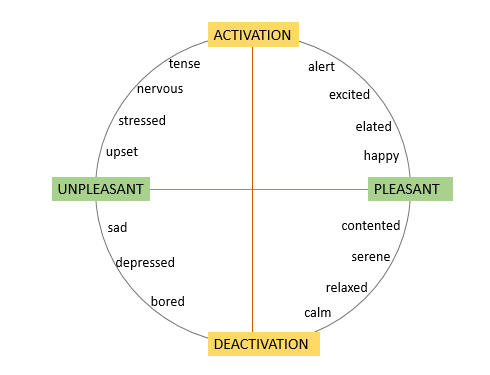
Russell J A. A Circumplex Model of Affect[J]. Journal of personality and social psychology, 1980, 39(6): 1161.
|
| [33] |
Reznik S J, Allen J J B. Frontal Asymmetry as A Mediator and Moderator of Emotion: An Updated Review[J]. Psychophysiology, 2018, 55(1): e12965.
|
| [34] |
Antonenko P, Paas F, Grabner R, et al. Using Electroencephalography to Measure Cognitive Load[J]. Educational psychology review, 2010, 22: 425-438.
|
| [35] |
Wang K Y, Ho Y L, Huang Y D, et al. Design of Intelligent EEG System for Human Emotion Recognition with Convolutional Neural Network[C]// 2019 IEEE international conference on artificial intelligence circuits and systems (AICAS). IEEE, 2019: 142-145.
|
| [36] |
Klimesch W, Schimke H, Pfurtscheller G. Alpha Frequency, Cognitive Load and Memory Performance[J]. Brain topography, 1993, 5(3): 241-251.
doi: 10.1007/BF01128991
pmid: 8507550
|
| [37] |
熊红川. 脑电Alpha节律研究[D]. 电子科技大学博士学位论文, 2010.
|
| [38] |
冯菲. 冷热媒介:合成语音与真人语音的不同传播效应——基于EEG的实验证据[J]. 新闻与传播研究, 2020(12).
|
| [39] |
Angelidis A, Hagenaars M, van Son D, et al. Do Not Look Away! Spontaneous Frontal EEG Theta/Beta Ratio as A Marker for Cognitive Control Over Attention to Mild and High Threat[J]. Biological psychology, 2018, 135: 8-17.
doi: S0301-0511(18)30170-4
pmid: 29518523
|