上海视觉

上海视觉 ›› 2026, Vol. 0 ›› Issue (2): 116-124.

• 艺术实践 • 上一篇    下一篇

基于文化基因分析的品牌视觉设计方法研究——以PURE咖啡为例

翁宜汐1, 毛磊3,4, 张孙晨2, 郗乐颖5   

  1. 1 南京师范大学南京 210023
    2 南京艺术学院南京 210013
    3 西交利物浦大学苏州 215123
    4 利物浦大学利物浦L697ZX
    5 南京工业大学浦江学院南京 211200
  • 出版日期:2026-06-20 发布日期:2026-07-20
  • 作者简介:翁宜汐(1989— ),男,南京师范大学博士,南京师范大学美术学院副教授。研究方向为生态设计、基于设计实践的理论与实践。
    毛磊(1998— ),男,英国利兹大学硕士,英国利物浦大学博士生,西交利物浦大学教学与科研助理。研究方向为工业设计。
    张孙晨(1990— ),男,南京艺术学院硕士,现为南京艺术学院助理研究员。研究方向为设计学。
    郗乐颖(2001— ),女,南京工业大学浦江学院学士,现为南京时恒电子科技有限公司设计师。研究方向为视觉设计。
  • 基金资助:
    2023年度江苏省社科基金项目(编号23YSCO11);南京师范大学2023年度新文科研究与改革实践项目,受江苏高校“青蓝工程”资助(编号2023XWK06)

Research on Brand Visual Design Method Based on Cultural Genetic Analysis: Taking “PURE” Coffee Brand as an Example

WENG Yixi1, MAO Lei3,4, ZHANG Sunchen2, XI Leying5   

  • Online:2026-06-20 Published:2026-07-20

摘要:

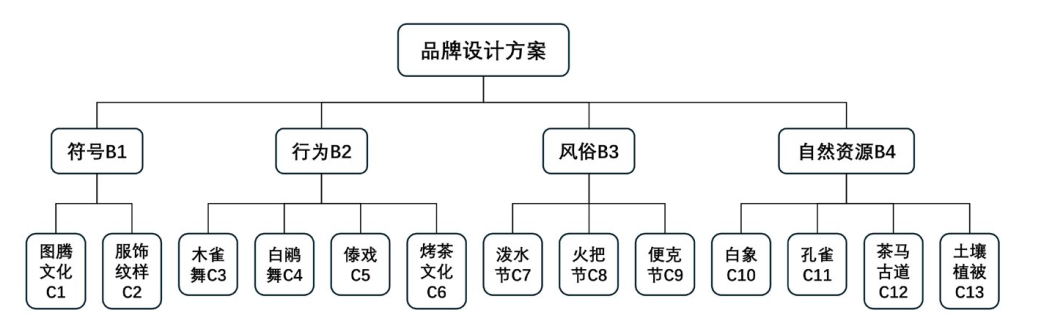
本研究是聚焦乡村振兴战略背景下,地域性民族品牌的视觉建构,以云南普洱咖啡作为设计实践对象,探索民族在地文化与都市消费文化的融合设计方法。首先,从符号、行为、风俗、地理资源四个维度的文化因子中筛选,组成普洱的地域文化基因库;其次,采用AHP方法分析地域品牌的构成要素和设计程序。再次,结合当地优势资源对地域文化在咖啡品牌形象中的策略进行探究。最后,构建从在地性到全球化的“PURE”普洱咖啡品牌形象,并通过量化分析等方法予以检验。研究表明,通过系统化转译地域文化基因,再以视觉设计方式所构建的多维应用场景,能够有效实现地域文化价值的商业转化,为乡村资源高质量发展提供新的视觉设计方式。

关键词: 品牌视觉, 文化基因, 民族文化, 层次分析法, 设计方法

Abstract:

This study focuses on the visual identity construction of regional ethnic brands under China’s rural revitalization strategy, using Yunnan Pu’er coffee as a case study to investigate integrated design approaches for bridging local place-based culture with urban consumer culture. The research framework unfolds through four phases. First, cultural factors were systematically extracted from four dimensions — symbolic representations, behavioral patterns, customary practices, and geographical resources — to establish a repository of Pu’er’s regional cultural DNA. Second, the Analytic Hierarchy Process (AHP) was employed to deconstruct the critical components and procedural logic of regional branding. Third, localized resource advantages were leveraged to formulate culturally embedded design strategies for coffee brand ecosystems. Finally, the branding model (Preservation, Universality, Relevance, Engagement) was developed to navigate the trajectory from locality-rooted authenticity to global resonance. And then tested it through quantitative analysis and other methods. The findings demonstrate that systematic transposition of regional cultural through multidimensional application scenarios effectively activates market-oriented cultural value conversion, proposing a replicable design-enabled paradigm for high-quality rural resource development.

Key words: Brand Vision, Cultural DNA, National Culture, AHP, Design Method