上海视觉

上海视觉 ›› 2026, Vol. 0 ›› Issue (3): 155-163.

• 教学探索 • 上一篇    下一篇

AI时代新艺科导向下民办艺术院校专业建设的结构重塑与实践路径——以上海视觉艺术学院为例

陈月浩, 李悦, 段士琳, 范希嘉   

  1. 上海视觉艺术学院, 上海 201620
  • 出版日期:2026-09-20 发布日期:2026-10-26
  • 作者简介:陈月浩(1978— ),男,同济大学工学博士,上海视觉艺术学院副教授,教务处处长,实训管理中心主任。研究方向为城市更新、社区营造、设计教育。
    李悦(1979— ),女,墨尔本大学城市设计硕士,上海视觉艺术学院副教授,学科与学术发展办公室主管。研究方向为生态环境设计、艺术疗愈、设计教育。
    段士琳(1983— ),女,华中师范大学理学硕士,上海视觉艺术学院,助理研究员,教务处教学建设主管。研究方向为教学管理。
    范希嘉(1973— ),女,上海大学设计学博士,上海视觉艺术学院教授。研究方向为社会创新、用户体验、设计伦理。
  • 基金资助:
    上海市教育科学研究项目“人工智能赋能高校应用型艺术设计人才培养的模式研究”(编号C2025219)

Structural Reconfiguration and Practical Paths of Major Construction in Private Arts Colleges Under the Guidance of New Art Disciplines in the AI Era: A Case Study of Shanghai Institute of Visual Arts

CHEN Yuehao, LI Yue, DUAN Shilin, FAN Xijia   

  • Online:2026-09-20 Published:2026-10-26

摘要:

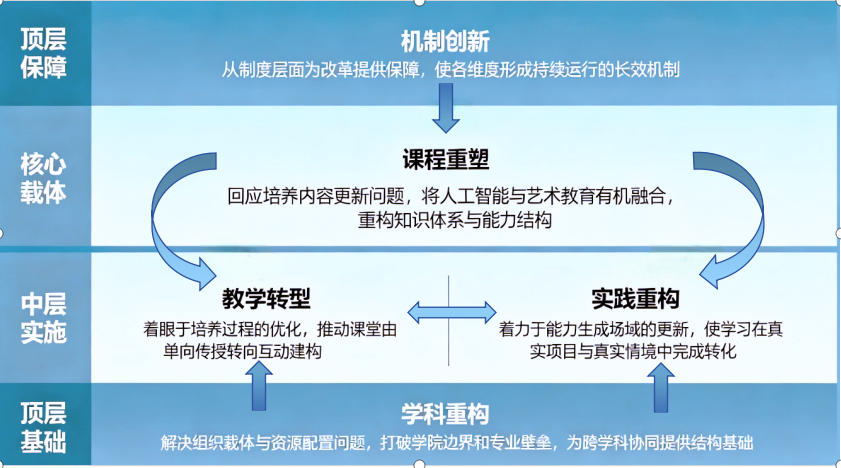
人工智能与数字技术正深刻改变艺术创作与创意产业的运行方式,艺术院校专业建设必然面临结构性调整。对民办艺术院校而言,“新艺科”建设并非简单增设技术课程或引入工具,而需要对学科组织、课程体系、教学方式、实践机制及评价制度进行整体重构。本文以上海视觉艺术学院为例,分析其面临的学科壁垒、课程滞后、实践浅层化、机制不足等现实困境,提出“学科重组—课程重塑—教学转型—实践重构—机制创新”五维协同改革模型。本文提出,将人工智能从外在工具转变为重组专业结构、更新课程内容、激活实践教学的内在变量,是“新艺科”建设的关键。本文提供了面向智能时代的复合型艺术人才培养路径:以跨学科专业群建设为平台,以分层递进的AI融合课程为载体,以真实项目驱动教学为方式,以多元评价机制为保障。所论案例为同类院校艺术教育转型提供了参照样本。

关键词: 新艺科, 人工智能, 民办艺术教育, 专业建设, 艺科融合

Abstract:

Artificial intelligence and digital technologies are revolutionizing the operational paradigms of artistic creation and creative industries, which inevitably necessitates a structural adjustment in the major construction of arts colleges. For private arts colleges, the development of new art disciplines does not simply entail the addition of technical courses or intelligent tools; rather, it demands a holistic reconfiguration of various elements, including disciplinary organization, curriculum systems, pedagogical methods, practical mechanisms, and evaluation systems. Taking the Shanghai Institute of Visual Arts as a case study, this paper analyses realistic predicaments—such as disciplinary barriers, curricular misalignment, shallow practices, and insufficient institutional support—and subsequently by proposing a five-dimensional collaborative model encompassing disciplinary reorganization, curriculum reshaping, pedagogical transformation, practical reconfiguration, and institutional innovation. This paper argues that the key to developing new art disciplines lies in transforming AI from an external tool into an internal catalyst that reorganizes major structures, updates the curriculum, and activates practical teaching. Furthermore, it delineates a path for cultivating interdisciplinary artistic talents oriented toward the intelligent era: by building interdisciplinary major clusters, deploying hierarchical and progressive AI-integrated courses, driving instruction through real-world projects, and ensuring success with a diversified evaluation mechanism. The case discussed herein serves as a model for the transformation of arts education in similar institutions.

Key words: New Art Disciplines, Artificial Intelligence, Private Arts Education, Major Construction, Integration of Art and Technology